
One small step forward.
Your Team Isn't Unproductive. They Might Just Lack Clarity.
When capable people are working hard but meaningful progress remains slow, the missing ingredient is often not effort. It is a shared understanding of what matters most and what happens next.
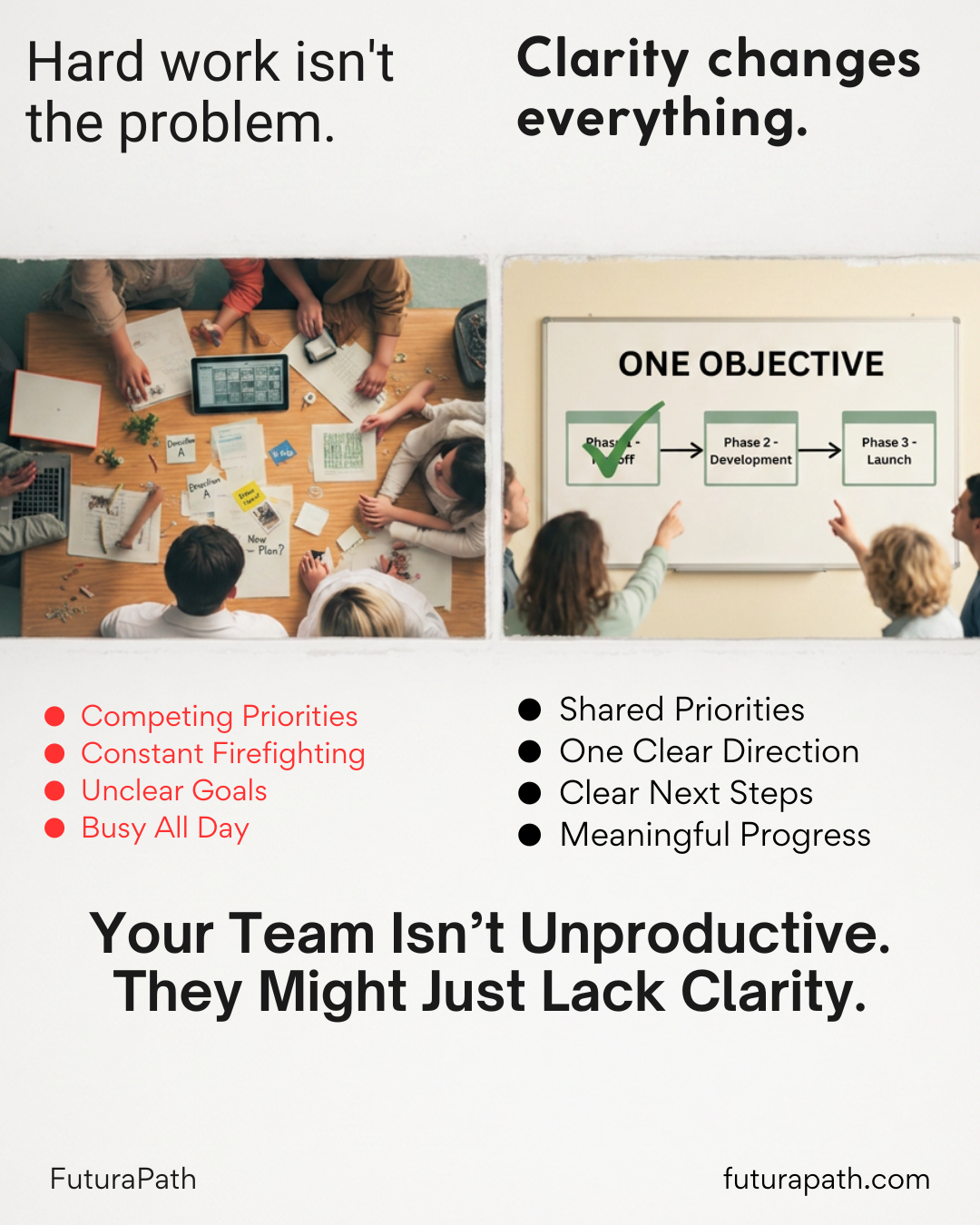
A surprising number of leaders believe their teams have a productivity problem.
They do not.
Most teams are already working extremely hard. People attend meetings, answer Slack messages, respond to email, handle production issues, review documents, move tickets, and help colleagues get unstuck. They move from one urgent task to another and finish the day with very little attention left.
From a distance, the organization looks active. Calendars are full. Channels are busy. Dashboards show work in progress. Yet several weeks later, the initiative everyone described as critical has barely moved.
The problem is not effort. It is clarity.
Teams rarely fail because people are lazy. They struggle because everyone is moving, but not necessarily in the same direction. When priorities compete, decisions remain unresolved, and the next step is vague, hard work gets absorbed by the system instead of converted into progress.
Movement is not momentum. A team can work at full capacity while the work that matters most remains almost stationary.
That distinction matters because a misdiagnosed problem produces the wrong response. If leaders assume the issue is motivation, they add pressure. If they assume the issue is discipline, they add process. If they assume the issue is visibility, they add reporting.
But when the real constraint is unclear direction, each of those responses creates more work around the work. The team becomes even busier while the central question remains unanswered: What matters most now?
Busy Does Not Equal Progress
Modern knowledge work makes activity unusually easy to produce and unusually hard to interpret. A resolved ticket, a quick reply, and a meeting attended are visible. A difficult architectural decision, a clearer product boundary, or an hour spent thinking through a risky migration may be less visible, even when it creates far more value.
This creates an understandable management trap. Leaders see motion and assume momentum. They see a quiet calendar and worry about capacity. Teams learn, often without anyone saying it directly, that responsiveness is safer than depth.
The result is an organization optimized to acknowledge work rather than finish important work. People become excellent at reacting. They keep inboxes moving, answer questions quickly, and maintain a constant sense of availability. But the strategic work—the platform redesign, the hiring plan, the operating model, the customer problem that crosses team boundaries—advances in fragments.
Consider an engineering team responsible for improving service reliability. On Monday, the team agrees that reducing repeat incidents is the priority. By Tuesday, a sales escalation pulls two engineers into a customer-specific request. Wednesday brings a production issue in a different service. Thursday is consumed by roadmap planning. On Friday, the reliability work is still technically in progress, but nobody had enough uninterrupted time to change the underlying system.
No one was unproductive. Every interruption had a reasonable explanation. The week failed at the level of leadership clarity: the organization never made the reliability objective strong enough to survive contact with competing demands.
This is why the feeling described in Busy All Day But Not Moving Forward is so common. Activity can be real and useful while still failing to accumulate into meaningful progress.
Productive teams do not merely complete more units of work. They direct a meaningful share of their energy toward the same outcome long enough for that energy to compound.
Competing Priorities Destroy Focus
Most organizations do not suffer from a lack of priorities. They suffer from an unwillingness to choose among them.
Everything is important. The customer commitment matters. The platform investment matters. The hiring plan matters. The cost target matters. The security review matters. Each senior stakeholder has one quick request, and each request is defensible when considered alone.
The problem appears when those requests meet inside the same week and depend on the same people.
A priority is not simply work that matters. It is work that receives preference when two worthwhile demands compete. Without that trade-off, a priority is only a statement of enthusiasm.
This is where opportunity cost becomes operational. Every time a team accepts a new urgent request, it spends more than the hours required to complete it. It delays something already underway, increases coordination overhead, and raises the probability that partially completed work will need to be reloaded, revised, or abandoned.
Constant roadmap changes are especially expensive because they weaken belief in the roadmap itself. After enough reversals, teams adapt rationally. They stop investing deeply in the current direction because experience tells them it may change again. Planning becomes provisional. Technical decisions become short-term. People wait for certainty or spread effort across several options to reduce the risk of backing the wrong one.
Leaders sometimes describe this as resistance to change. Often it is a learned response to unstable priorities.
Clear prioritization therefore requires a visible no. If the new enterprise request moves to the top, what moves down? If the regulatory deadline cannot shift, which product scope will? If reliability is the quarter's defining objective, which feature work will not begin?
The absence of those answers does not preserve flexibility. It transfers the conflict to the team, where it is resolved through context switching, overtime, quiet quality compromises, and stalled work.
A team can support several important outcomes over time. It cannot treat all of them as the most important outcome at the same moment.
Context Switching Costs More Than Leaders Realize
Interruptions are often measured by their visible duration: a five-minute message, a fifteen-minute call, a quick review before lunch. For knowledge workers, that measurement is incomplete.
Engineering work depends on mental state. To change a complex system safely, a developer may need to hold the failure mode, recent code changes, data flow, test assumptions, and operational constraints in working memory. A product leader comparing roadmap options is doing something similar with customer evidence, dependencies, commercial commitments, and sequencing.
When that work is interrupted, the clock does not simply pause. Part of the previous task remains mentally active, while the new task requires a different model. Reconstructing the original context later takes time and introduces risk.
Harvard Business Review has summarized this problem through the idea of attention residue: interruptions fragment both time and attention, and the mind does not switch cleanly between unfinished tasks.
The manufacturing metaphor can mislead leaders here. Moving a person from one physical station to another may reduce throughput by the minutes spent moving. Moving an engineer from a database migration to a pricing bug, then to an incident review, can erase a much larger block of effective capacity because each problem has its own invisible setup cost.
Cal Newport describes the value of sustained, distraction-free concentration as deep work. Paul Graham makes a related organizational distinction in Maker's Schedule, Manager's Schedule: a meeting that fits neatly into a manager's divided calendar can break the long block a maker needs to produce.
This does not mean teams should become unreachable or that operational work should be ignored. It means interruptions need an explicit design. Rotations can protect most of the team from incidents. Office hours can collect non-urgent questions. Clear escalation criteria can separate a true emergency from a request that merely arrived with urgency in its tone.
The leadership question is not whether communication is good or bad. It is whether the organization has made focused work structurally possible.
When every person must remain available to every issue, the team has not created collaboration. It has created a shared interruption system.
Teams Need One Clear Direction
High-performing teams are not free from ambiguity. Their markets change, systems fail, and plans encounter reality. What distinguishes them is that they know which ambiguity they are trying to resolve.
At any meaningful point in time, a focused team can usually answer four questions:
- What matters most right now?
- Why does it matter to customers, the business, or the mission?
- What evidence will tell us we have succeeded?
- What are we deliberately not working on?
These answers create a decision system. They help an engineer choose between a broad refactor and a narrow reliability fix. They help a product manager decide whether a new request belongs in the current release. They help a director respond to a stakeholder without escalating every conflict to an executive.
Imagine a platform team told to improve developer experience. The phrase sounds clear until work begins. One group proposes faster builds. Another wants better documentation. A third argues for a new deployment tool. All three may be valuable, but the objective does not yet help the team choose.
Now make the direction concrete: reduce the median time for a new service to reach production from ten days to two by the end of the quarter, without weakening security controls. The team knows the user, the friction, the measure, and the constraint. Documentation, automation, and platform work can now be evaluated against the same outcome.
The Atlassian Team Playbook uses a useful framing here: define the goal, the signals that indicate movement, and the measures that define success. That keeps attention on outcomes instead of allowing completed outputs to create a false sense of accomplishment.
One clear direction does not require one task or one opinion. A team can explore several approaches, divide work, and adapt its plan. The unity is in the outcome, not in the method.
Clarity also needs repetition. Leaders often believe they have communicated a priority because they announced it at an all-hands or placed it at the top of a planning document. Teams experience the organization through hundreds of later decisions. If those decisions contradict the message, the real priority becomes whatever wins in practice.
Break Large Objectives Into Clear Next Steps
Direction at the top is necessary, but it is not sufficient. A team can understand the strategy and still lose momentum because the work immediately in front of them remains too large or undefined.
Large objectives conceal decisions. Improve onboarding. Modernize the platform. Strengthen leadership capability. Expand into a new market. Each phrase points somewhere useful, but none tells a person what to do at 9:30 on Tuesday morning.
Uncertainty increases with distance. When the next action is unclear, people fill the gap in predictable ways: they gather more information, schedule another alignment meeting, polish a plan, or choose an easy task that provides a sense of completion.
Small next steps change the texture of the work. They create a visible action, shorten the feedback loop, and give the team something concrete to learn from.
For the onboarding objective, the next step might be to watch three recent customers attempt the first-run experience. For the platform objective, it might be to document the current deployment path for one representative service. For the leadership objective, it might be to write the decision rights that are currently causing two managers to collide.
These are not reductions in ambition. They are how ambition enters reality.
Clarity should exist at every level: the company vision explains the direction; quarterly objectives define the current outcomes; projects create a coherent path; weekly priorities protect attention; and today's next step makes action possible.
This is the practical logic behind micro-goals. A large goal can provide meaning while a small, specific action provides traction. The two belong together.
Leaders sometimes resist small steps because they look insignificant beside the scale of the objective. But progress on complex work is rarely linear. A small experiment can eliminate a weak option. A short customer conversation can change the roadmap. A one-page decision record can prevent weeks of circular debate.
Waiting for a complete plan can become another form of delay. As Why Waiting Until You Feel Ready Keeps You Stuck explains, action often creates the clarity people expect to have before they begin.
The right next step is not merely small. It is small and connected: modest enough to begin, meaningful enough to teach, and clearly related to the outcome the team has chosen.
What Great Leaders Do Differently
Leadership clarity is not a well-written strategy deck. It is a set of repeated operating choices.
Great leaders repeat priorities more often than feels necessary. They connect decisions back to those priorities and explain when conditions have genuinely changed. Repetition is not a lack of sophistication; it is how a shared direction survives the noise of daily work.
They remove work. When a new commitment enters, they identify what will pause or stop. They understand that capacity planning without subtraction is only wishful thinking.
They say no with context. A useful no does not dismiss the request. It explains the trade-off: this work matters, but accepting it now would delay the reliability target we agreed was most important. That language protects relationships while keeping the priority real.
They protect focus time and design sensible interruption paths. They do not ask people to do deep work while rewarding immediate responses to every message.
They clarify ownership. One accountable owner does not mean one person performs all the work. It means the team knows who is responsible for moving the decision forward, surfacing risks, and closing loops.
They define success before work expands. Without a finish line, projects absorb more ideas, more stakeholders, and more polish. A clear measure creates permission to stop.
And they celebrate meaningful progress, not visible exhaustion. The engineer who prevented repeat incidents, the manager who removed an unnecessary project, and the team that learned early that an idea would not work may have created more value than the group with the longest activity report.
For a practical way to translate this leadership posture into personal and team-level focus, see How leaders can use FuturaPath to focus on the work that matters.
None of these practices is dramatic. Their power comes from consistency. Over time, they teach the organization that priorities have consequences, focus will be protected, and clear decisions are valued more than performative busyness.
Clarity Is a Leadership Practice
Teams do not need more pressure. They need more clarity.
They need to know which outcome matters most, why it matters, what success looks like, and which work can wait. They need enough protected attention to think, and a next step clear enough to begin.
When those conditions exist, productivity stops being something leaders try to extract. It becomes the natural result of capable people directing their effort toward the same meaningful outcome.
FuturaPath was built around this same philosophy. Whether you are organizing personal goals or leading larger initiatives, progress becomes easier when the next step is clear.
One small step forward.
One Clear Next Step
Ready to bring more clarity to your work?
FuturaPath helps individuals and leaders turn overwhelming goals into clear, manageable next steps—so meaningful progress becomes easier to sustain.