
One small step forward.
How Leaders Can Use FuturaPath to Focus on the Work That Matters
A practical, flexible way to move from scattered demands to clear priorities, protected attention, meaningful action, and reflection.
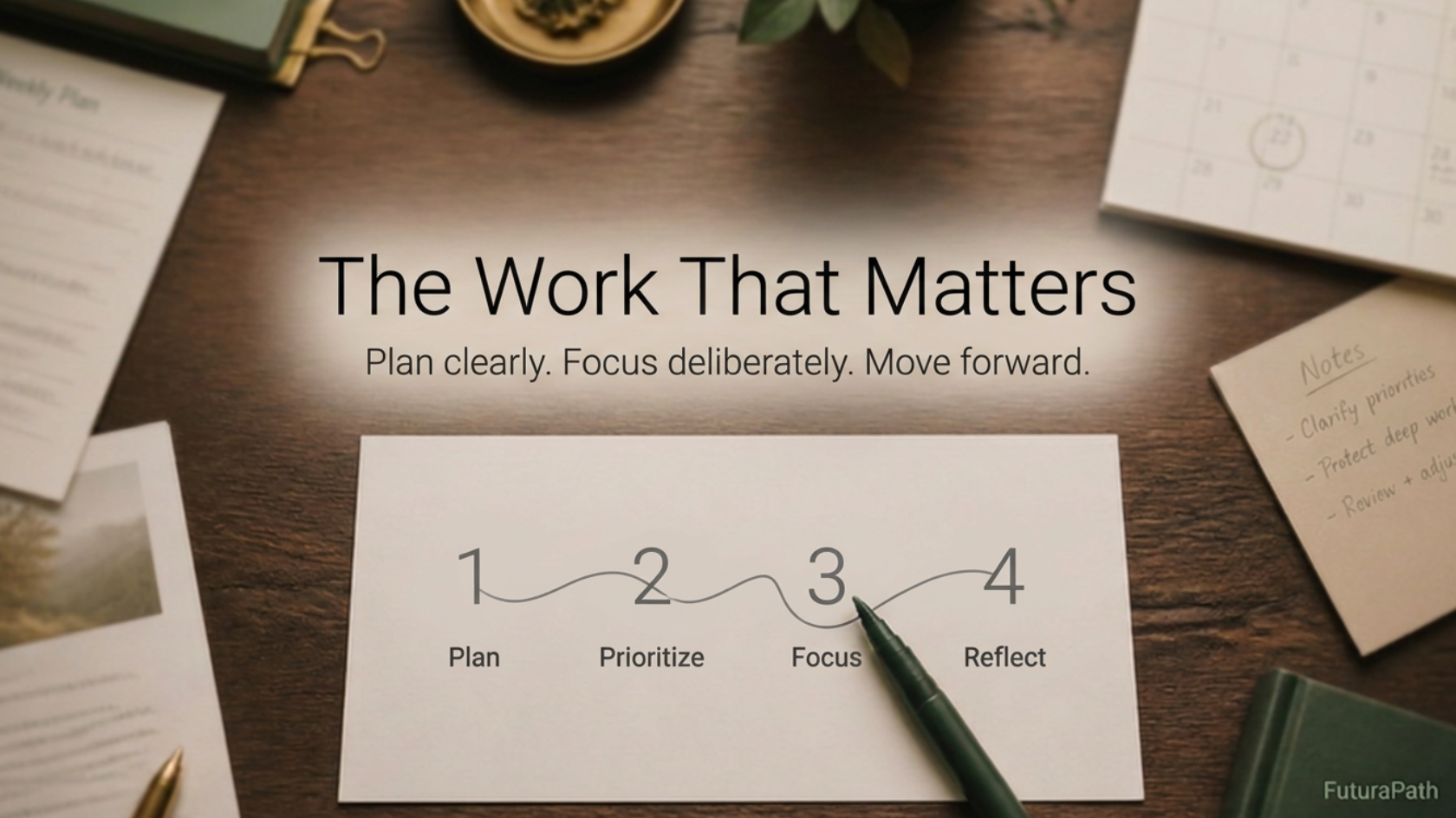
Leadership rarely arrives as one clean list. Messages, meetings, approvals, urgent problems, career decisions, financial planning, health, learning, and family responsibilities all compete for attention at the same time.
Much of that work is necessary. The difficulty is that it often lives in different places: a notebook for ideas, a spreadsheet for goals, a calendar for commitments, an email draft for something unfinished, and memory for everything that has not found a home.
A leader can work hard all day and still be unsure what matters most, what deserves attention now, what should be explored, what should become a goal, what should be reduced or dropped, and what the next meaningful action actually is.
FuturaPath is a personal system for making those decisions. It is built for individuals managing their own leadership growth, professional priorities, career, finances, health, learning, focus, and follow-through. It is not a team workspace, employee-monitoring system, or delegation platform.
This guide presents one practical way to use FuturaPath. It is a guideline, not a rule. Start with the parts that make your work clearer and leave the rest until they are useful.
The goal is not to become a better taskmaster. It is to spend more time on work that improves, prevents, and grows something important.
The dependable FuturaPath loop is intentionally small: open Dashboard, choose one Micro-goal, complete it, reflect, and choose the next Micro-goal.
Planning Sheet, Goal Map, Supporting Tasks, Focus Review, Schedule, reminders, and Insights can strengthen that loop when they are available and genuinely helpful. None of them needs to become ceremony for its own sake.
Why Leaders Lose Sight of Important Work
Leaders are rewarded for responsiveness. A message arrives, a decision is waiting, a meeting needs preparation, or an operational problem has become visible. Each demand has a person, a deadline, or a consequence attached to it.
Important work is often quieter. Strengthening a process, preparing for retirement, developing a leadership skill, improving health, learning something difficult, or making a thoughtful career decision may matter enormously without creating an immediate alarm.
When those two kinds of work share the same day, urgent work usually wins because it is already specific. Important work remains broad, emotionally heavier, and easier to postpone.
A useful personal planning system should help you decide:
- what matters most now
- what deserves exploration before commitment
- what should become a formal goal
- what should be reduced, redirected, deferred, or dropped
- what the next meaningful action is
- whether your effort is producing real progress over time
FuturaPath does not decide those things for you. It gives your decisions a connected place to live so they are less likely to disappear into scattered notes or repeated mental reminders.
Planning Sheet: Think Before You Commit
Planning Sheet is one trusted place to capture and shape an idea, goal, or potential piece of work before it becomes an active commitment.
A Planning Sheet draft can move through Idea, Exploring, Ready, or Dropped. That status movement is useful because it separates curiosity from commitment. An idea can be worth thinking about without immediately becoming another active goal.
As the draft becomes clearer, consider whether it may become a long-term goal, short-term goal, supporting task, or Micro-goal.
Add only the context that helps you decide: priority, target date, intended outcome, a related goal, a draft next step, or notes. Not every field needs to be completed.
Planning Sheet is not simply a storage table. Its purpose is to help you understand what an item is, why it matters, and what should happen next. When a draft is Ready, you can review how it will become structured work before you commit it. Formal goal creation is available with Pro.
Idea → Exploring → Ready → structured action — or Dropped
This is especially useful when an initiative is otherwise spread across:
- a notebook page you rarely revisit
- an Excel or Google Sheet row without a next decision
- an email draft used as a reminder
- a sticky note with no context
- a thought you keep carrying in memory
Planning Sheet may not appear for every account yet. When available, it gives you a dedicated place to shape ideas before turning them into active goals or next steps. You can still begin directly with a Micro-goal.
Dashboard: Know Where to Begin
Dashboard is the daily orientation surface. Open it when you begin the day, return after an interruption, or realize you have lost the thread of what you intended to do.
Its practical question is simple: What deserves my attention now? Review active work, look at what is approaching or overdue, and check what is already in motion before creating anything new.
Then choose the most meaningful current Micro-goal. If no existing action is useful, create one. Later, return to mark progress or choose the next action rather than rebuilding the day from memory.
Dashboard is available to Free and Pro users. It is your daily command centre for deciding what deserves attention and choosing the next meaningful Micro-goal.
Focus Review: Step Back From Urgency
Focus Review is a deliberate pause from reactive work. It is useful when the immediate list is not enough and you need to reconsider what should remain in focus, what should wait, and what should leave your attention.
It is not a mandatory daily ritual. Use it when the questions are strategic rather than merely operational.
A thoughtful review might ask:
- What matters most right now?
- Which outcome deserves attention?
- What is the next meaningful action?
- What should wait or be removed?
- Is this work improving, preventing, or growing something important?
- Am I choosing, or only reacting?
Focus Review helps you pause, reconsider priorities, and choose what deserves attention. Availability and some actions may vary by plan.
Move Beyond Fighting Fires
Routine and urgent work will not disappear. The aim is not to ignore it. The aim is to protect enough attention to reduce the number of problems that keep returning.
The reactive question is: How do I fix today's issue? The strategic question is: Why does this keep happening, and what should change so it happens less often?
Imagine a recurring production incident. Each incident requires messages, investigation, approvals, and recovery. Responding is necessary. But if every week ends with another response and no preventive work, the same pattern keeps consuming attention.
Recurring issue → inspect previous incidents → identify the common cause → clarify ownership → improve the process → add a preventive control → review whether the change worked
A useful first Micro-goal is:
- Review the last three incidents and write down the common cause.
Use one decision filter: Does this work only help me respond, or does it improve, prevent, or grow something important?
Improve means making a process, skill, decision, system, habit, or outcome better. Prevent means reducing future risk, confusion, rework, repeated incidents, or avoidable stress. Grow means building capability, opportunity, knowledge, health, career strength, financial security, or personal development.
Goal Map: Connect Direction to Action
Use Goal Map when an outcome needs more structure than a single next action. Its hierarchy connects long-term direction to a short-term milestone, supporting work, and the smallest action you can execute now.
Formal long-term and short-term goal writes are Pro features. Every short-term goal is a milestone beneath a long-term goal. Supporting tasks and Micro-goals can then connect the hierarchy to actual work.
- Strengthen financial security for retirement
- Create a clear retirement-income plan
- Review all retirement accounts
- Record the current balance of each account
The hierarchy is optional. Not every idea needs a goal tree, and not every Micro-goal needs a formal goal. Use structure where it makes direction easier to understand, then return to the immediate next action.
Use the Supporting Task Priority Matrix
Supporting tasks represent committed work that is larger than one Micro-goal. They are available to Free users within current limits and to Pro users. In Goal Map, the priority matrix gives each task a decision—not merely a label.
Tasks can move between quadrants as circumstances change. Drag a task or use its Move action whenever its urgency or importance changes. FuturaPath records your own decision; it does not assign work to another person.
- Act, define the immediate Micro-goal, or protect time.
- Protect strategic, preventive, growth, financial, health, learning, or career work before it becomes urgent.
- Reduce, redirect, simplify, automate, or clarify ownership where appropriate.
- Move it out of active work when it no longer deserves attention.
For the recurring-incident example, place the supporting task Prevent recurring production incidents under Not Urgent + Important. Then create the Micro-goal Review the last three incidents and identify the common cause. The matrix preserves the decision; the Micro-goal makes it executable.
Micro-Goals: Keep Execution Focused
A Micro-goal is a concrete next action with a clear definition of done. It should be small enough to begin without repeating the entire planning process.
Micro-goals are available to Free users within current plan limits and to Pro users. A practical guideline is to keep no more than three active Micro-goals in your current execution focus. That is not a product limit, and the wider system can contain many ideas, goals, and supporting tasks. You may choose a different number.
Complete or deliberately adjust current work before adding more. If a Micro-goal expands while you are doing it, finish the stated action and create a new next step rather than silently turning one action into a project.
Do Not Multitask
Meaningful progress is difficult when attention is repeatedly switched between unrelated work. During a focus block, choose one Micro-goal and let its definition of done set the boundary.
If the Micro-goal is Draft the opening section of the proposal, the same block is not also for email, messages, another spreadsheet, a second goal, or unrelated administration. Those things may still need time; they do not need the same time.
One task. One block of attention. One clear definition of done.
This is not a demand for perfect concentration. It is a practical way to make returning to the important action easier whenever attention wanders.
Schedule: Protect Time for What Matters
Important work is often displaced when no time is reserved for it. When Schedule is available to you, use it to protect time for work that should not be left to chance.
Schedule can support strategic thinking, planning, writing, financial review, career development, learning, health, preparation, Micro-goals, and a weekly review. Scheduling is optional; the core workflow still works without it.
- Review the last three incidents and identify the common cause
- List retirement accounts and current balances
- Complete the next lesson in a professional course
Schedule is available with Pro access and may be introduced gradually. When it is available to you, use it to protect time for work that should not be left to chance. The core FuturaPath workflow still works without scheduling.
Use Deadlines and Reminders Carefully
A realistic target date gives a commitment a boundary and makes it easier to review at the right moment.
Set target dates and reminder preferences so important work is easier to return to. Reminder delivery depends on your selected preferences and available notification methods.
FuturaPath reduces the need to rely on memory by keeping target dates and reminder preferences connected to the work.
Use reminders to support:
- a dated commitment you want to revisit
- a Micro-goal connected to focused time
- a weekly review or important milestone
Use reminders as support, not as the only place where a critical obligation exists. Keep the work itself visible on Dashboard, in Micro-goals, or in the appropriate planning surface.
The Adaptable 85/15 Guideline
As a practical experiment, aim roughly 85% of planned focus time toward work that improves, prevents, or grows something important, and roughly 15% toward administration, exploration, experimentation, and other necessary work.
This balance is not enforced by FuturaPath. It will not fit every week, and a highly reactive week may look very different. The purpose is simply to notice when low-value urgency has taken over all planned attention.
Practical guideline: up to three active Micro-goals and an adaptable 85/15 focus balance—not enforced limits.
Adapt the ratio to your responsibilities. What matters is making a deliberate place for prevention, improvement, and growth before every available block is consumed by reaction.
Reflection: Record Wins, Friction, and Lessons
Reflection closes the loop. It is available to Free and Pro users. Use it at the end of a day, after meaningful work, or whenever friction is trying to teach you something.
Reflection is not only for problems. Record what moved forward, what was completed, what became difficult, what caused distraction, what you learned, what deserves recognition, and what the next Micro-goal should be.
Wins worth recording might include:
- finishing a presentation
- preventing a recurring issue
- making a difficult decision
- completing a financial review
- reaching a health milestone
- practising a leadership skill
- handling an important conversation well
Over time, reflections and wins can become a useful personal record when preparing for a performance review, promotion conversation, résumé update, interview, annual plan, or personal progress review. FuturaPath does not automatically generate those documents; it helps you preserve the evidence and learning you may want to use.
Reward Meaningful Milestones
Completing a meaningful milestone deserves recognition before it is immediately replaced by more work. Pause long enough to notice that something changed because you followed through.
A healthy reward can be simple: a walk, a favourite meal, reading for pleasure, time on a hobby, a guilt-free break, or another enjoyable activity that fits your life.
Recognition is not a distraction from progress. It helps progress become visible, especially for people who are used to seeing only what remains unfinished.
Insights: Learn From Patterns
Insights is a Pro view that helps you notice patterns in activity already recorded in FuturaPath. It becomes more useful as goals, actions, reflections, wins, and friction build a clearer picture over time.
Insights does not measure every minute, predict outcomes, or automatically decide what you should do. Treat it as a learning and adjustment tool.
Questions it may help you explore include:
- Which goals are moving forward?
- Which repeatedly stall?
- Are too many Micro-goals active?
- Does protected time appear to support completion?
- Are the same obstacles recurring?
- Is effort going toward improvement, prevention, and growth—or mainly reaction?
Use the pattern to ask a better question, then make the actual decision yourself and express it as a clearer goal, task, or Micro-goal.
A Practical Weekly Review
A short weekly review keeps FuturaPath from becoming another static list. The aim is not to admire a perfectly organized system. It is to remove stale work and make the coming week's first meaningful action clear.
Once a week, consider this routine:
- review active goals and their target dates
- move Planning Sheet drafts among Idea, Exploring, Ready, or Dropped when Planning Sheet is available
- remove work that no longer matters
- shrink Micro-goals that are still too large
- reconsider supporting-task quadrants
- check whether planned focus time reached meaningful work
- record wins and useful lessons
- choose the next intentionally small set of active Micro-goals
- adjust the coming week
Focus Review can support this pause when it is available to you. It is not required. A simple Dashboard, Micro-goal, and Reflection review is enough to maintain the dependable core loop.
The Practical FuturaPath Rhythm
The full rhythm is easier to remember when every surface has one job.
- Use Planning Sheet, when available, to capture and shape ideas, outcomes, priorities, target dates, and draft next steps.
- Use Dashboard to review active work.
- Use Focus Review selectively to separate meaningful priorities from noise and reaction.
- Use Pro Goal Map and Supporting Tasks where larger outcomes need organization.
- Use the matrix to do, plan, reduce or delegate, defer, or drop.
- Keep the active Micro-goal list intentionally small and work on one thing at a time.
- Use Schedule, target dates, and reminder preferences when available and appropriate.
- Complete the next meaningful Micro-goal.
- Record progress, friction, lessons, and wins.
- Use Pro Insights to notice patterns after enough activity exists.
- Return to the most useful planning surface and decide what happens next.
The rhythm can be as short as Orient → Focus → Act → Reflect. Add the other stages only when they improve the quality of the decision.
Make the Method Your Own
There is no single mandatory way to use FuturaPath. You may start in Planning Sheet when it is available, create a Micro-goal directly, use Goal Map only for larger goals, reflect daily or weekly, use Schedule selectively, keep two active Micro-goals instead of three, or adjust the 85/15 balance.
Use only the tools that reduce uncertainty or help you follow through. If a feature makes a simple action feel heavier, return to Dashboard and write one clear Micro-goal.
The application should support your judgment, not replace it. The calmest system is often the one that contains enough structure to help and no more.
The Work That Matters
The goal is not to become a better taskmaster. It is not to fill every hour, turn every idea into a goal, or measure your worth by the length of a completed list.
The goal is to spend more time on work that improves, prevents, and grows something important—and to make the next meaningful step clear enough to begin.
Choose one important priority. Turn it into one focused Micro-goal. Complete it, reflect, and choose what deserves to happen next.
FuturaPath
One small step forward.
FAQ
Do I need to use every FuturaPath feature?
No. The dependable core is Dashboard, one Micro-goal, completion, and Reflection. Add goals, tasks, review, scheduling, reminders, or Insights only when they make your next decision clearer.
Should every idea become a goal?
No. An idea may remain exploratory, become a small action, wait, or be dropped. When Planning Sheet is available, it can help you make that decision before creating formal work.
How many Micro-goals should I keep active?
Up to three is a practical execution guideline, not a FuturaPath product limit. Choose the number that helps you focus, and deliberately complete or adjust current actions before adding more.
Can I use FuturaPath for personal and financial goals?
Yes. FuturaPath is for an individual's professional and personal priorities, including career development, finances, health, learning, leadership growth, and other meaningful goals.
Does FuturaPath assign work to other people?
No. FuturaPath records your own priorities, decisions, goals, tasks, and next actions. It is not a team delegation or employee-monitoring system.
Is Schedule available to every user?
Schedule is available with Pro access and may be introduced gradually. The practical FuturaPath workflow does not require scheduling.
How often should I use Reflection?
Use it daily, weekly, or after meaningful work—whatever helps you preserve progress, friction, lessons, and wins without turning reflection into another burden.
Is the 85/15 approach a fixed rule?
No. It is an adaptable guideline for noticing whether reaction has consumed all planned attention. Reactive weeks and different responsibilities may require a different balance.
One important step
Choose one important priority and turn it into a clear next step.
Begin with the smallest meaningful action you can complete, then build only the structure that helps.