
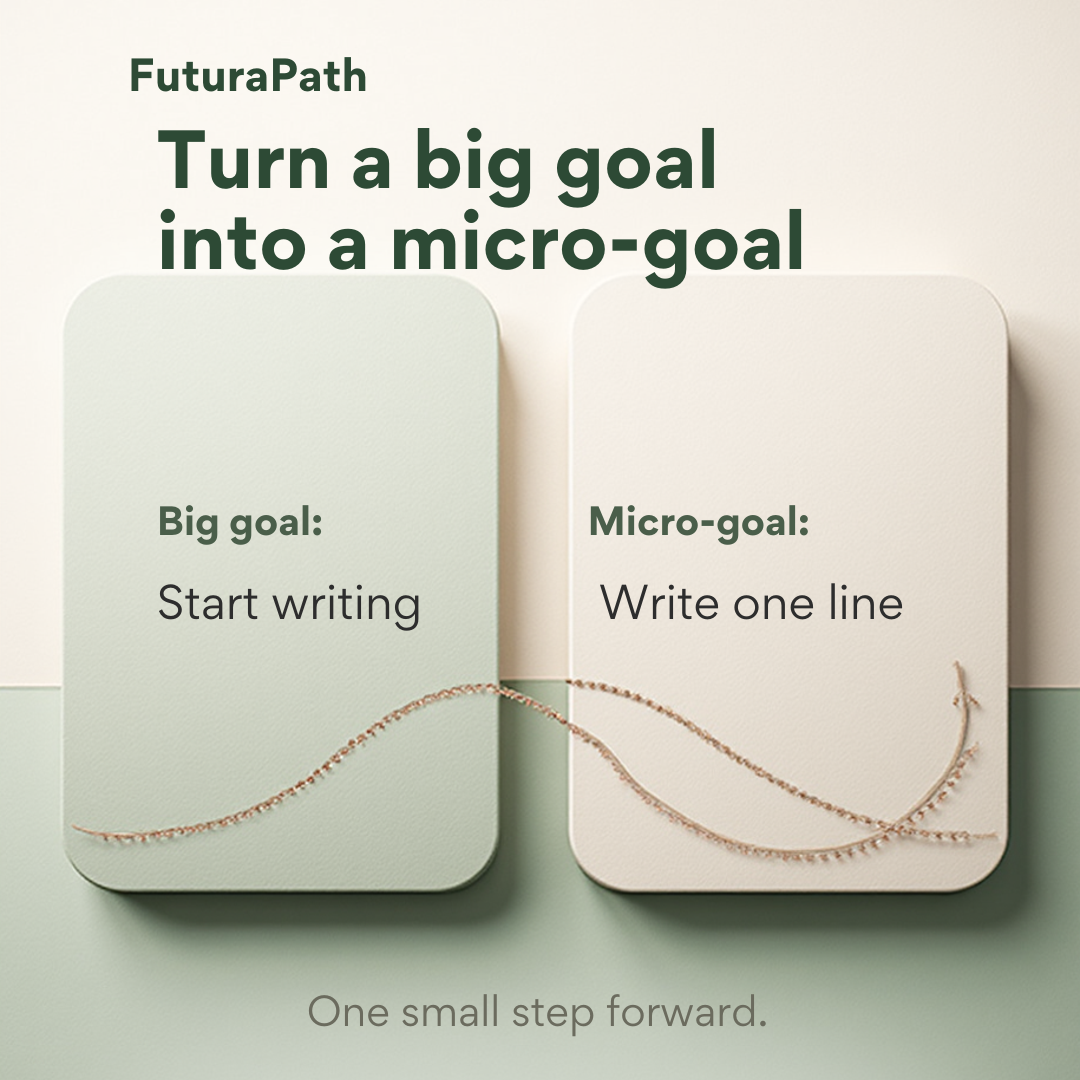
One small step forward.
How to Turn a Big Goal Into a Micro-Goal
A big goal gives you direction. A micro-goal gives you something clear enough to begin.
Big goals are often meaningful for exactly the reason they are hard to start. They point toward something you care about, but they rarely tell you what to do next.
That is where many goals stall. The intention is real, but the starting line is still too vague.
A micro-goal helps by turning the bigger goal into one action small enough to begin. The point is not to shrink the importance of the goal. The point is to shrink the first move.
A micro-goal is the next action small enough that starting feels possible.
That definition matters because it keeps the focus on action, not ambition.
If you want a fuller foundation for the idea itself, What Are Micro-Goals? How Tiny Steps Help You Start When Goals Feel Too Big explains why micro-goals reduce friction at the moment of starting.
What Is a Big Goal?
A big goal usually describes a direction, outcome, or change you want to create.
It might sound like get fit, start a business, clean the house, find a new job, improve my finances, or be more consistent.
These are meaningful goals. The problem is not that they are too ambitious. The problem is that they do not clearly tell you what to do next.
A big goal often gives you direction without giving you a starting action:
- Get fit
- Start a business
- Clean the house
- Find a new job
- Improve my finances
- Be more consistent
That gap between direction and action is where people often get stuck.
A goal can be meaningful and still be too broad to use in a real day.
What Is a Micro-Goal?
A micro-goal is the next action small enough that starting feels possible.
It is not defined by a strict time limit. Some micro-goals take two minutes, while others take longer. What matters is that the step is clear, small, and believable enough to begin.
That is what makes a micro-goal different from a broad intention. It gives the goal a usable surface.
This connects naturally with How to Stop Procrastinating When a Goal Feels Too Big, because procrastination often grows when the next step is too vague to touch.
A micro-goal does not replace the bigger goal.
It gives the bigger goal a beginning.
Why Big Goals Need Smaller Starting Points
Big goals create friction because they require decisions before action.
Before you can move, your brain starts asking questions like where do I begin, what is enough for today, what if I choose the wrong step, and do I need a full plan first.
That decision load makes starting harder than it needs to be.
If the whole goal already feels emotionally heavy, How To Start When Everything Feels Overwhelming can help you shrink the starting point before you try to organize everything.
Big goal -> too many decisions -> more friction -> delay -> more pressure
A smaller starting point lowers that pressure.
It gives your brain one thing to do instead of ten things to solve.
The Simple Conversion Question
When a goal feels too large, ask a simpler question first.
What is the next visible action I can take?
And if that still feels heavy, ask a second question: What is one step small enough that starting feels possible?
Those questions turn a vague goal into something your hands and attention can actually do.
You are not trying to build the whole plan in one sitting.
You are trying to find one action clear enough to begin.
Step-by-Step Process
You can turn a big goal into a micro-goal with a very simple process.
Keep going only until you arrive at one visible action.
Try this sequence:
- Step 1: Name the big goal.
- Step 2: Notice why it feels hard to start.
- Step 3: Choose one visible action.
- Step 4: Make the action smaller.
- Step 5: Stop at one micro-goal.
If the micro-goal still feels too hard, it is probably still too large.
Make it smaller again instead of pushing harder.
Examples
Here is what the conversion can look like in practice.
These steps work because they are visible and specific.
They do not ask you to solve the whole goal before motion begins.
What Makes a Good Micro-Goal?
A good micro-goal is specific, visible, small enough to begin, connected to a bigger intention, and free from unnecessary setup.
If the action still requires a lot of hidden preparation, it may not yet be a true starting step.
A good micro-goal is usually:
- specific
- visible
- small enough to begin
- connected to a bigger intention
- free from unnecessary setup
The best micro-goal is not the most impressive one.
It is the one you can actually imagine doing.
What to Do After Completing One Micro-Goal
After the first step, the next step usually becomes easier to see.
You do not need the whole plan before beginning. Reflection and optional scheduling can help later, but they are not required to get started.
That is one reason micro-goals are helpful. They create movement first, then clarity often follows.
This is part of the broader pattern we describe in Why Big Goals Fail and How Micro-Goals Build Momentum. Sustainable progress usually starts smaller than people expect.
Choose the next step after the first step, not before every detail feels perfectly organized.
That keeps the process lighter and easier to repeat.
How FuturaPath Helps
FuturaPath helps you bring in a bigger goal, turn it into one micro-goal, and keep the next step visible.
You can add optional scheduling, gentle reminders, and reflection when helpful.
The experience is meant to support action without requiring you to organize your whole life first.
Big goal -> Micro-goal -> Optional scheduling -> Gentle reminders -> Reflection when helpful
The goal is not to create a heavier system.
The goal is to make starting easier.
One Small Step Forward
A big goal matters because it points toward something you care about. A micro-goal matters because it gives you a place to begin.
Bring one goal you have been avoiding. FuturaPath can help you turn it into one micro-goal you can start today.
FAQ
What is the difference between a big goal and a micro-goal?
A big goal describes the outcome or direction. A micro-goal describes one small next action you can actually take.
How small should a micro-goal be?
Small enough that starting feels possible. Some micro-goals take two minutes; others take longer. The important part is that the step is clear and believable.
Can one big goal have many micro-goals?
Yes. A big goal can be supported by many micro-goals over time, but you only need to choose one to begin.
What if my micro-goal still feels too hard?
Make it smaller. If go for a walk feels too much, try put walking shoes by the door.
Start Here
Bring one goal you have been avoiding.
FuturaPath can help you turn it into one micro-goal you can start today.