
One small step forward.
How to Stop Procrastinating When a Goal Feels Too Big
When a goal feels too large to touch, the calmer move is not more pressure. It is one small action you can actually begin.
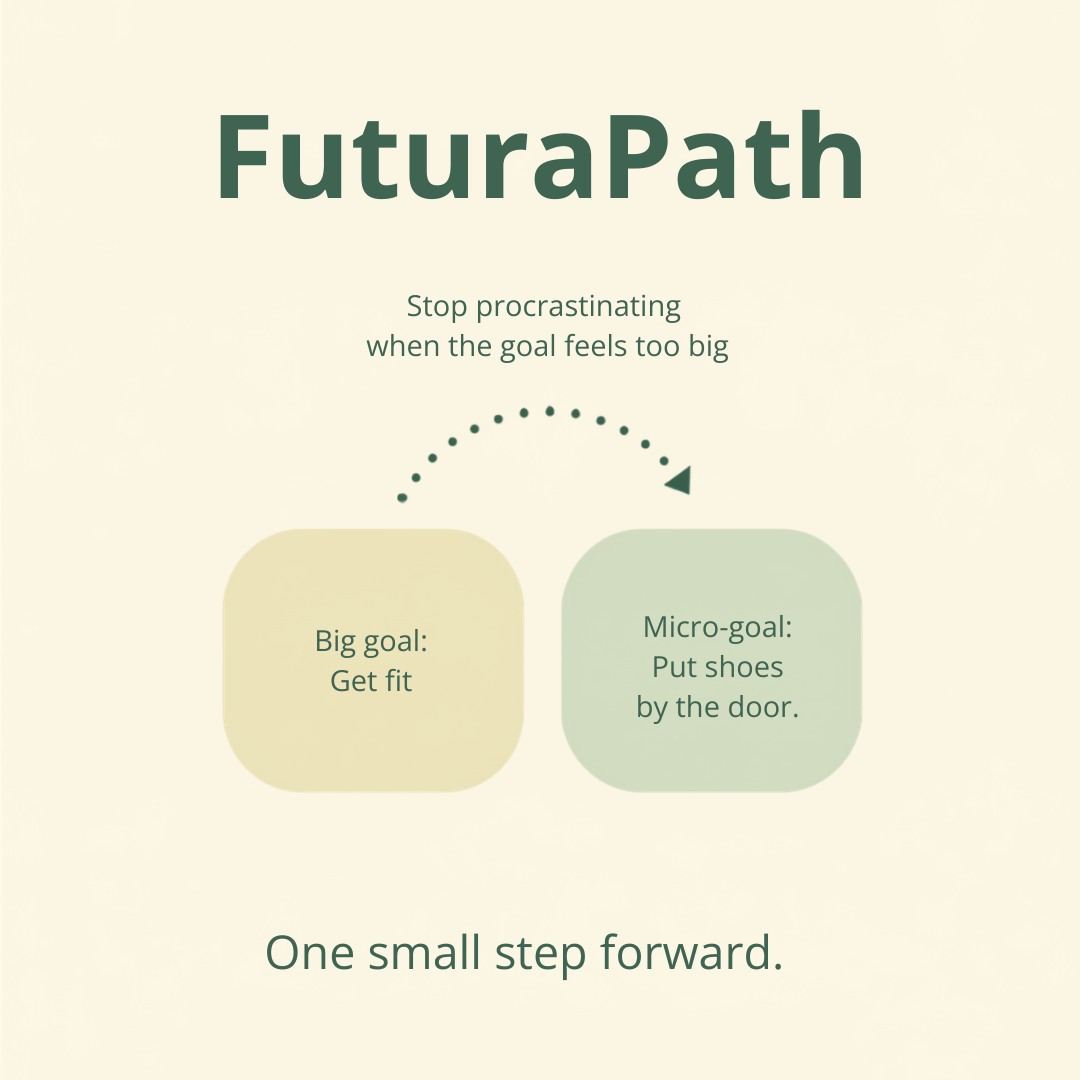
Procrastination often shows up around goals that matter.
You want to make progress. You may even know why the goal is important. But when the goal feels too big, too vague, or too emotionally loaded, it becomes strangely easy to avoid.
That does not always mean you need more discipline. Often, it means the next step still is not clear enough to begin.
What is one step small enough that starting feels possible?
That question changes the job. Instead of asking yourself to solve an entire future, it asks you to find one visible action you can use today.
If you want the broader foundation behind this approach, What Are Micro-Goals? How Tiny Steps Help You Start explains why smaller next steps reduce friction in the first place.
Why Big Goals Create Resistance
Goals like get fit, start the project, clean the house, or figure out my future can be meaningful and still be very hard to begin.
The problem is not that they are bad goals. The problem is that they are too broad to act on immediately. They contain too many possible starting points, too many decisions, and too much emotional weight.
A big goal often carries hidden questions like:
- Where do I begin?
- What counts as enough for today?
- Do I need a full plan first?
- What if I choose the wrong starting point?
When all of that shows up at once, avoidance can feel easier than action.
That is one reason a goal can matter deeply and still feel strangely untouchable.
Procrastination Is Often a Clarity Problem
People often describe procrastination as a motivation problem. Sometimes it is closer to a clarity problem.
If the next move is vague, your brain has to keep solving the task before it can even begin the task. That extra mental load creates friction right at the moment of action.
Instead of one step, the goal becomes a cloud of questions, options, and pressure.
If stuck already feels heavier than the task itself, How To Start When Everything Feels Overwhelming goes deeper on lowering pressure before you try to plan.
Vague goal -> too many decisions -> more resistance -> delay -> more pressure
That loop can make procrastination feel personal, even when the real issue is that the entry point is still too abstract.
Clarity does not solve every problem, but it often makes the first move possible.
The Mistake Is Trying to Solve the Whole Goal
When a goal feels heavy, many people try to compensate by thinking bigger. They search for the perfect system, the perfect plan, the perfect time block, or the perfect burst of motivation.
But trying to solve the whole goal before you begin often creates more delay, not less. It quietly turns a starting problem into a life-organization problem.
The result is familiar: you spend more time preparing to move than actually moving.
You do not need the whole map before taking the first step.
You need one action that feels clear enough to use.
Ask a Better Question
A more useful question is not How do I finish this? or How do I get fully motivated?
A better question is: What is one step small enough that starting feels possible?
That question lowers the pressure immediately. It narrows the task from a huge identity-level problem into one visible action.
This is closely related to what we described in Why Motivation Is Unreliable and What Works Instead. You do not always need more motivation first. Often, you need a next step small enough that action can begin before motivation arrives.
A good micro-goal is not impressive. It is usable.
That is what makes it powerful.
How to Turn a Procrastinated Goal Into a Micro-Goal
When you notice yourself avoiding a goal, try this calmer sequence instead of building a full plan.
Keep it light. Stop as soon as the next step becomes obvious.
Try this process:
- Name the bigger goal.
- Notice why it feels heavy or vague.
- Pick one visible next action.
- Make that action smaller.
- Stop before turning it into a full plan.
If the step still feels resistant, it probably is not small enough yet.
Shrink it again until you can imagine doing it today.
Examples
Here is what it looks like when a large goal becomes a smaller starting surface.
None of these solves the entire goal. That is exactly why they work.
They create a beginning instead of demanding a full transformation.
What to Do After the First Micro-Goal
After one small step, the next step usually becomes easier to see.
You may keep going. You may stop after the first action. Both are fine. The goal is not to finish everything today. The goal is to create movement.
Momentum often looks ordinary at first. It begins with one action that makes the second action feel less mysterious.
If you recognize the feeling of understanding the goal but still not being able to begin, Why You Know What To Do But Still Can't Start pairs well with this article.
Once the first step is visible, the whole goal usually becomes less emotionally loud.
That is often enough to keep going.
How FuturaPath Helps
FuturaPath helps you take a goal that feels too big and turn it into one visible micro-goal.
You can add optional scheduling, gentle reminders, and reflection when helpful, without needing to organize your whole life first.
The point is not to pressure you into a perfect productivity system. The point is to make the next action clearer and easier to begin.
Big goal -> One visible micro-goal -> Optional scheduling -> Gentle reminders -> Reflection when helpful
That is the calmer alternative to waiting for the full plan, the perfect mood, or the right time.
Movement usually starts smaller than people expect.
One Small Step Forward
When a goal feels too big, procrastination often is not a sign that you do not care. It is a sign that the next step still needs to get smaller.
You do not need to solve the whole goal today. You need one action clear enough to begin.
Bring one goal you have been avoiding. FuturaPath can help you turn it into one small step you can start today.
FAQ
Why do I procrastinate when a goal is important?
Important goals can feel heavy because they carry pressure, uncertainty, or too many decisions. Shrinking the goal into one clear next step can make starting easier.
What is the first step to stop procrastinating?
Choose one action small enough to begin. The first step should be specific, visible, and doable without needing a full plan.
Are micro-goals the same as tasks?
A micro-goal is a small action connected to a bigger intention. It is not just a task. It is a starting point that makes progress feel possible.
How small should a micro-goal be?
Small enough that you can imagine doing it today. Some micro-goals take two minutes; others take longer. The point is that the step feels clear and believable.
Start Here
Bring one goal you have been avoiding.
FuturaPath can help you turn it into one small step you can start today.