
One small step forward.
Busy All Day But Not Moving Forward? How Leaders Can Find the Work That Matters
Being busy is not the same as moving forward. Start by choosing one important priority and turning it into one focused micro-goal.
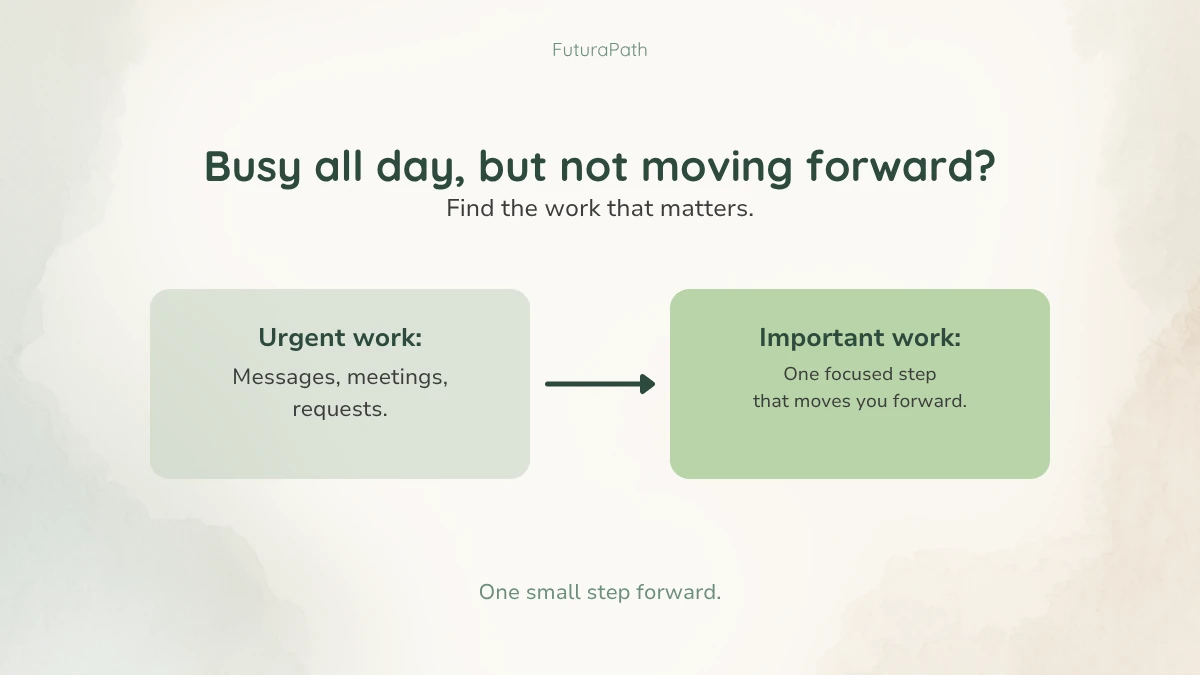
A leader can have a full calendar, a clean inbox, and a long list of handled issues, then still end the day with the uncomfortable feeling that the real work did not move.
That does not mean the day was wasted. It means urgent work may have crowded out important work.
FuturaPath helps with this exact moment: turning a meaningful but stuck priority into one visible micro-goal that is clear enough to begin.
The work that matters is often not the loudest work in the room.
That is the problem with important work. It rarely interrupts you as aggressively as a message, approval, meeting, or request from someone else.
It waits quietly. And because it waits quietly, it is easy to keep postponing it while still feeling productive.
Why Busy Can Still Feel Stuck
Leadership often rewards responsiveness. You answer the message, unblock the person, make the decision, join the meeting, review the work, and keep the machine moving.
Those actions matter. But they can also make the day feel complete before the important priority ever receives your full attention.
The result is a specific kind of frustration: you were active all day, but the thing that would change the shape of the week stayed untouched.
For a leader, that important priority might be:
- building a clearer strategy
- having the conversation you keep postponing
- documenting a process so your team can move without you
- making a decision that has been sitting in ambiguity
- creating space for business development, hiring, or visibility
- repairing a pattern that keeps draining attention
The issue is not that urgent work is fake work.
The issue is that urgent work can consume the entire day unless important work is made specific enough to compete.
Urgent Work Versus Important Work
Urgent work usually announces itself. It has a deadline, a notification, a person waiting, or a visible consequence if you do not respond.
Important work is different. It often has no immediate alarm. It may be strategic, relational, creative, or structural. It matters because of what it prevents or unlocks over time.
That makes important work easier to respect in theory than to protect in practice.
A useful day can contain both. But if urgent work is always clearer than important work, urgent work will keep winning.
Why Leaders Avoid the Work That Would Move Them Forward
Important work often carries more weight than routine execution. It may involve judgment, uncertainty, conflict, visibility, risk, or a decision that cannot be perfectly optimized.
That emotional weight can make the next step feel less obvious. And when the next step is not obvious, the mind often reaches for work that is easier to complete.
Avoidance can look very polished at a leadership level:
- checking one more metric before making the decision
- rewriting the plan instead of sharing the first version
- handling every small request before naming the real priority
- staying available to everyone else instead of protecting one block of focus
- waiting for a better mood, a clearer calendar, or a less complicated week
If this feels familiar, What To Do When You Feel Mentally Blocked explains how a vague or emotionally loaded task can make the first step harder to see.
The solution is not to shame yourself into more intensity. The solution is to make the important work easier to start.
Priority Friction
Priority friction is what happens when important work is buried under too many urgent, unfinished, or unclear demands.
It is not only a time problem. It is a clarity problem. The leader may technically have a few minutes, but the important priority still feels too large, too undefined, or too costly to touch between other obligations.
When priority friction is high, even a meaningful goal can feel strangely inaccessible.
Too many open loops -> unclear priority -> harder starting point -> more delay -> more open loops
The way out is not always a bigger productivity system.
Often, the way out is one clearer next action.
Ask a Better Question
When the day is full and the important work keeps slipping, the usual question is not helpful enough.
What do I need to get done today? can produce a long list of everything competing for attention. A better question is narrower.
What work, if moved forward slightly, would make the rest of this week lighter, clearer, or more honest?
Then ask one more question: What is the next visible action?
The goal is not to solve the entire leadership problem in one sitting.
The goal is to identify the work that matters and make the first move visible.
Turn One Important Priority Into a Micro-Goal
Once you have named the important priority, resist the urge to build a full plan immediately.
A full plan can be useful later. But when the priority has been stuck, the first job is to lower the friction enough to begin.
This is the same practical move explained in How to Turn a Big Goal Into a Micro-Goal: keep shrinking the action until it is specific enough to start.
Try this process:
- Name the important priority in plain language.
- Write why it matters now.
- Choose one visible action, not a full outcome.
- Make that action smaller if it still feels heavy.
- Stop when the next step feels clear enough to begin.
A micro-goal is not a small version of your ambition. It is the first usable action connected to that ambition.
For a busy leader, that distinction matters. You do not need more pressure. You need a cleaner starting point.
Examples
Here is what important work can look like when it becomes a concrete micro-goal.
These examples are intentionally small because the first step should not require the same energy as the whole goal.
If a goal feels too big to begin, How to Stop Procrastinating When a Goal Feels Too Big goes deeper on why shrinking the action reduces delay.
Do Not Turn the Restart Into Another System
High-achievers can turn even a restart into a performance project. The plan gets bigger. The template gets more polished. The standard rises before the first action happens.
That can feel productive, but it often rebuilds the same friction in a more sophisticated form.
For this moment, keep the restart almost boring: one priority, one reason it matters, one visible next action.
This is also why motivation is unreliable as the main strategy. A clear next action is easier to use than waiting for the perfect internal state.
Momentum does not always arrive before action. Often, it arrives after the first small action has made the situation feel less stuck.
How FuturaPath Helps Leaders
FuturaPath is built for the moment when an important priority is real, but the next step is still too vague to start.
You bring the priority. FuturaPath helps you turn it into one micro-goal, keep that next step visible, and add gentle scheduling or reminders only when they help.
For a leader-specific overview, visit FuturaPath for leaders.
For the complete product workflow, read How Leaders Can Use FuturaPath to Focus on the Work That Matters.
Important priority -> One focused micro-goal -> Optional scheduling -> Gentle reminders -> Reflection when helpful
The aim is not to add another layer of pressure to a full life.
The aim is to make the work that matters easier to begin.
One Important Step Forward
If you are busy all day but not moving forward, the answer may not be a larger plan or a stricter schedule.
It may be one important priority, made small enough to start today.
FAQ
Why do I feel busy all day but not productive?
You may be handling urgent work while important work stays unclear or unprotected. Responsiveness can fill the day, even when the work that would create meaningful progress remains untouched.
How can leaders identify the work that matters most?
Start by asking which priority, if moved forward slightly, would make the week lighter, clearer, or more honest. Then choose one visible next action connected to that priority.
What is a micro-goal for leaders?
A micro-goal for leaders is one clear, focused action connected to an important priority, such as drafting the first sentence of a difficult conversation or naming the decision your team needs this week.
What should I do when everything feels urgent?
Do not try to solve the whole list at once. Name the one priority that matters most right now, then make the next action small enough to begin without needing a full reset.
Start Here
Bring one important priority that keeps getting pushed aside.
FuturaPath can help you turn it into one focused step you can begin.